Monday, 2 November 2009
Feeding the Children
It was lunchtime and I was rummaging through the kitchen trying to find something to stop the regular cries of "I'm hungry!"
There was little to give them as we had planned on doing some shopping that afternoon, so, what to do? Then my eyes settled on a bag of rice. "A-ha!" I thought and put some on to cook in a 50/50 mix of milk and water. I added sugar AND honey, then when it was cooked, called the chldren.
"What! Rice? By itself?" complained the boy.
"Try it," I said
The boy dipped his spoon into the rice and tasted a couple of grains. The look of surprise on his face was a picture. "Wow! Natasha, come and try this!"
In the end, I had to make a second batch as they enjoyed my take on rice pudding. It's a pity I didn't have an oven to do the job properly.
It also occurred to me that the Twiga OVCs would have been happy with a bowl of cooked, unsweetened rice. Different strokes ...
*OVC: orphaned or vulnerable child
Sunday, 12 July 2009
Things That Go Bump In The Night In Kenya
One of the major disadvantages of living in a house with a corrugated steel roof is the noise when something lands on said roof. Even with a false ceiling, the noise of a bird landing on the roof can be heard.
Especially at night.
At dusk, standing outside, bats can be seen flitting around. These aren't the cute little things one sees in the South of England, these are like raptors, enormous things!
And they roost in trees, where they return, carrying their staple diet, fruit - because they are probably fruit bats. Now, there are a lot of mango trees around in Kenya, so these bats come home with a mango, eat the flesh and drop the stone.
I am sure that most readers have seen the stone of a mango, it is big, and when one is dropped onto a corrugated steel roof, it makes rather a lot of noise. There is the initial clang as it lands, but
then a sort of grating slide as it slips off the roof towards the gutter.
The first time I was subjected to this, i jumped out of bed and grabbed the panga (machete) standing in the corner of the room. I was convinced the house was being broken into (this was soon after the post-election violence of 2008). As the second stone hit the roof, I realised what it probably was, and calmed down and eventually got back to sleep.
-oOo-
On my most recent visit to Kisii, the area suffered an earth tremor. I have mentioned this in an earlier post. I was instantly awakened when the house started to vibrate. The noise was terrifying, and realising what was going on, my mind drew a mental picture of where the house was situated.
We were in the lowest of three rows of little bungalows on the side of a steep side of a valley with a river at the bottom.
My next vision was of the hillside collapsing as we had had torrential rain for the last few days.
The rumbling, grinding vibrations went on for about 20 or 30 seconds, although it seemed a lot more at the time.
I lay there, waiting for an after-shock, or whatever happens in these situations, but none occurred.
It was terrifying, and this was just a little tremor, there was no structural damage. Things didn't even fall of shelves. In fact, when i got up in the morning, I wondered if i had dreamt it.
But I hadn't. Vincent, my host talked about it. But he said that in his 28 years in Kisii, there had never been a similar incident as far as he could remember.
And it was the last one that occurred while I was there. This was a very minor tremor and it got me thinking of the people who live in areas prone to major earthquakes. If I was scared by a minor tremor, what do these people feel?
Thinking about it, Kisii, is not that far from the Great Rift Valley, described as the area where the continent of Africa is ripping itself apart. This is evident when you are in the valley. There are volcanoes running the length of it. They are extinct, or at least dormant and most are now lakes, supporting an abundance of wildlife.
Although I have driven past it several times, I still get a thrill when I pass Suswa or Oldoinyo Nyukie, an impressive conical volcano on the road between Nairobi and Narok.
-oOo-
Of course, it is not only fruit bats that drop things on the roof.
Where I was staying on the coast, there was a mango tree overhanging the house and from time to time, a fruit would fall, especially if the ocean breeze was a little stronger than usual. There were also a lot of coconut palms, well laden with fruit, but luckily, it wasn't the season for them to drop.
Tuesday, 17 March 2009
Why Kisii?
There is no rainy season as such. It can rain pretty much all year round, and the soil in the area is extremely fertile, except where it has been over-farmed.
The area was a coffee-growing area, but due to difficulties in receiving payment, the local farmers have reverted to subsistence crops.
The area also supports bananas, avocados, pineapples and other exotic fruits.
So, why have I made my base in Kisii town? I have been asked this many times, so it is about time to put the answer down "on paper".
Then, a few years ago, I was asked to manage the Rhino Ark website. Rhino Ark is a conservation charity in Kenya, so there it was, a (rather tenuous) connection to Africa.
A little later, I was contacted by ACIS, a Nairobi-based organisation, asking if I could supply cheap computers to schools in Kenya (I was, and still am a computer consultant in the UK). I couldn't help, but in conversation, I got roped into building them a website.
Soon afterwards, a children's home in Kisii contacted me, also looking for computers. Again, I offered to build them a website. We communicated regularly and became cyber friends.
Then, purely by chance, I met a rather pretty, intelligent, educated, Luyha lady over the Internet. She lives on the coast with her two children.
With all this going on, I was beginning to plan on going out to Kenya, which I finally managed in September 2007.
I was hosted by the director of the Nairobi-based organisation, who made me very welcome. He booked my coach to the coast so that I could meet up with my lady friend (that worked out rather well, by the way!).
On my return to Nairobi, I met people at WHO and KeNAAM. Then I arranged a trip out to Kisii to visit the children's home.
As soon as I arrived, I was "adopted" by a cute little boy, Josephat, who dubbed me his Baba Mzungu (hence the blog name). I met many of the kids, and was shown the plot where it was hoped the orphanage would be built.
I returned to the UK after a month in Kenya, and vowed to return as soon as possible.
I did, in March 2008, after a delay caused by the post-election troubles.
I went straight to Kisii, where I stayed for about 10 days as a guest of my friends Vincent and Abigael, the directors of the children's home. I made another vow. I wanted to work with Vincent and Abigael, in Kisii.
After another 10 days on the coast to see my "New family", I returned to Nairobi, where I stayed a further 10 days.
Upon my return to the UK, I started to work on the projects we had discussed.
Vincent and I eventually decided to form a new organisation, KCIS, of which we would both be directors, or trustees, and we would incorporate the children's home, renamed Twiga (giraffe in Swahili).
Vincent, Abigael and I are now ready to start the practical work that we have been planning for a year. We will turn the plot into a shamba (farm), where we will install the projects, grow food for the children, hopefully with a surplus that we can sell.
So, that is "Why Kisii?" Pure chance, if you believe in chance, or was I guided there?
Saturday, 17 January 2009
Kids ... heat, and clothes
The day had been humid and hot, 35°C, and I was enjoying the slight drop in temperature as I sat in the warm breeze off the Indian Ocean.
Natasha wormed and squirmed to get comfortable, then settled to look at the enormous moon hanging in the sky.
I was so content as I felt the heat coming off her little body, but we were interrupted from our contemplations by the house girl who insisted on putting a fleece on Natasha. That broke the spell. Natasha fidgeted and squirmed on my lap and would not settle, so I took her indoors, where she immediately divested herself of the fleece.
I went back outside to finish my contemplations and was again joined by Natasha, minus her fleece. She installed herself again on my lap and settled. In two minutes she was asleep.
The house girl again came out and insisted that she put the fleece on the little girl, but I refused to let her, telling her that I would bring her indoors if I thought she felt cold.
We sat, me staring at the Moon, and Natasha dreaming of ... whatever little girls dream of, hopefully something to do with her new Baba Mzungu.
It never gets cold in this spot. Night-time temperatures rarely drop below 22°C, which to me, a Brit, is warm.
But it got me thinking. My significant other, Natasha's mother Liz and her two kids were born and raised in this place, this holiday paradise of white coral sands, palm trees, blue ocean, coral reef and wall-to-wall sunshine. Liz left when she attended boarding school, but came back to her oven of a village.
The two kids had never been subjected to a temperature of less than 20°C in their lives. What would they make of England, even in Summer? Where even in Summer, nights are cool, and in winter, they are in the minuses.
Snow and ice, frost, fog, woolly jumpers and tights, socks, boots, quilted jackets, warm hats, underwear?
Ah yes, underwear.
Ian, who is six, insists on wearing a singlet and pants under his school uniform. The pants I can understand. Sitting cross-legged on the floor, wearing shorts without underpants can be, let us say, revealing to the others in his class. But a singlet, in an area where daytime temperatures are always in the mid 30s?
And when he comes home from school, he strips off and puts on a T-shirt and shorts. No vest, no pants, no socks.
Oh to be a child again.
Thursday, 14 August 2008
My Take on Kenya
There is no doubt. I love Kenya.
There are some places I like more than others, but that must be true of just about any country in the world - and of course, I don't know the whole country, only little bits of it: the Nairobi area, especially the business district and the eastern suburbs, Kisii and Malindi.
That's quite a spread, though, Coastal, to over 5,500ft, village to major town to rural town.
I find the Malindi area too hot and too humid. I don't really like it.
Nairobi and its suburbs are fascinating. But I am a country boy and I have an inbuilt dislike of big cities. The public transport system has deteriorated since I have been going to Nairobi. It used to be reasonably easy to get from my base in the east suburbs to the office in the business district on top of the hill. Now it is virtually impossible.
Kisii is what I would expect a large African town to be. Chaotic, dusty (when it is not raining) noisy, busy. I like Kisii.
And then there are the people. Naturally. top of the list is my love interest, beautiful, intelligent, well educated, living on the coast.
There is the man in Nairobi that started my Kenyan adventure. He is very very friendly, plausible and pleasant, but is always finding ways of borrowing money to "invest". I don't suppose I will ever see it again. He is always trying to impress, introducing me to Daktari This and Hon. That. His promises are big but never forthcoming.
And then there is the couple I met in Kisii, young, enthusiastic, well educated, friendly, caring, honest.
I like Kisii, and I have good friends there.
So I have set up business there, with a view to ecventually settling down near the town.
Why Aren't I there already? That's personal, but I have good reason to remain at my base in the UK - most of the time. I will travel to Kenya whenever I can. The only restraint is the money for the air fare. I have managed a couple of visits within the last year, and I am about due to go out there again, as soon as I have found the money for the ticket.
But one day, I will arrive and never leave.
Thursday, 1 May 2008
Living Conditions
I have been meaning to write this for a long time, but life has grabbed me by the throat and kept me in the real world - that is the world of having to work, rather than writing blogs.
While I was in Kenya in March, I lived with Kenyans, ordinary Kenyans, in their homes.
So, where to start? I suppose, with my living conditions in the South of England.
I live in a large bungalow in a small village. Our property backs onto the lands of an ancestral home, so it is calm.
The bungalow has the usual central heating, lighting, telephone line, fitted kitchen, bathroom, shower room, three bedrooms and two living rooms, two TVs - it is a "normal", middle class abode. I have a car, not new, but reliable. I have two computers and a laptop, all permanently connected to broadband.
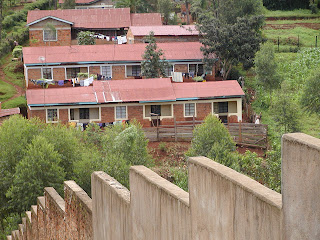
My first stop in Kenya was Kisii, where I stayed for 10 days with friends, Vincent and Abigael. They live in a rented two-bedroomed bungalow comprising a sitting room, kitchen, wet room and the two bedrooms.
There is no electricity or running water and the toilet is a deep-pit latrine 20 or 30 yards from the house.
Most of the garden is for growing food and Vincent has also bought a second plot adjacent, to grow more.
I felt rather guilty as, being a guest, I had been given the "good" bedroom. I shared it with one of the kids, Josephat. Everyone else slept in the other bedroom. This suited Jojo, as he never strayed more than about 3 feet from me the whole time I was there. He has decided that I am his Baba Mzungu (white Dad).
Lighting is by kerosene lamp in the main room and by torch or candle anywhere else.
The kitchen is a room with a couple of low work surfaces, no running water and no cooker. Cooking is over kerosene or charcoal.
Water is brought up from the river every day by a water carrier and has to be boiled.
Internet connection is out of the question, so collecting emails, etc., involves a trip into town to visit one of the many cyber cafés.
The wet room is just a room with a small hole in the wall to let out water. Having a wash involves heating water in the kitchen and carrying it into the wet room in a bowl.
Despite being a "soft" European, I survived. No - more than that. I actually enjoyed my stay there. I happily put up with what I saw as deprivation. OK, going to the loo during a downpour was a bit of a pain, but hey! This is Kenya!
The second leg of my stay was far more "civilised". I had arranged to use an apartment in the village on the coast, sharing it with my girlfriend and her two children.
This apartment comprises a massive living room with dining area, a kitchen with a combi cooker (two gas rings, two electric), although the electric part is not connected, and a fridge/freezer, a bathroom with a bath with shower, "real" toilet, basin and running water (only cold). The bedroom has a king-size and large single bed.
There is electricity, although only one power point in each room. There is also a TV in the living room. The whole is finished off with a large, east-facing balcony.
Few of the windows are glazed. It is not necessary, the temperature never falls below 20C. They are all covered with mosquito-proof netting.
This leg of my stay in Kenya was luxury - a real shower, a real toilet, a real kitchen. And then, of course, I was with my girlfriend!
The third leg was in a suburb of Nairobi. My friend there has a four-bedroom terraced house with a front and back yard. It is in a gated estate with security guard.
The house comprises two floors. Upstairs, there are two bedrooms and a bathroom, the ground floor has the living room, kitchen, wet room, a guest bedroom and with access from the front yard there is the fourth bedroom. Normally this might have been the domestic quarters, or workroom.
The kitchen is basic, but does have electricity and running water, although it is not advisable to drink it.
The wet room has an "Asian" toilet which flushes, a basin and a shower head, again giving only cold water.
Cooking is over kerosene or charcoal, but every room has electric light, as long as the supply is working!
This was very comfortable, and I could happily live in this house, but it was not as "comfortable" as the apartment on the coast. Nor would I particularly want to live close to Nairobi.
Given the choice of the three places I know, I would settle in Kisii - the coast is just too hot.
This stay in Kenya, particularly Kisii, reminded me of just how lucky I am, living where I do.
But even the house in Kisii would be considered luxury to many Kenyans, who live in small traditional mud huts under thatch, not through choice, but because they can afford nothing better.